
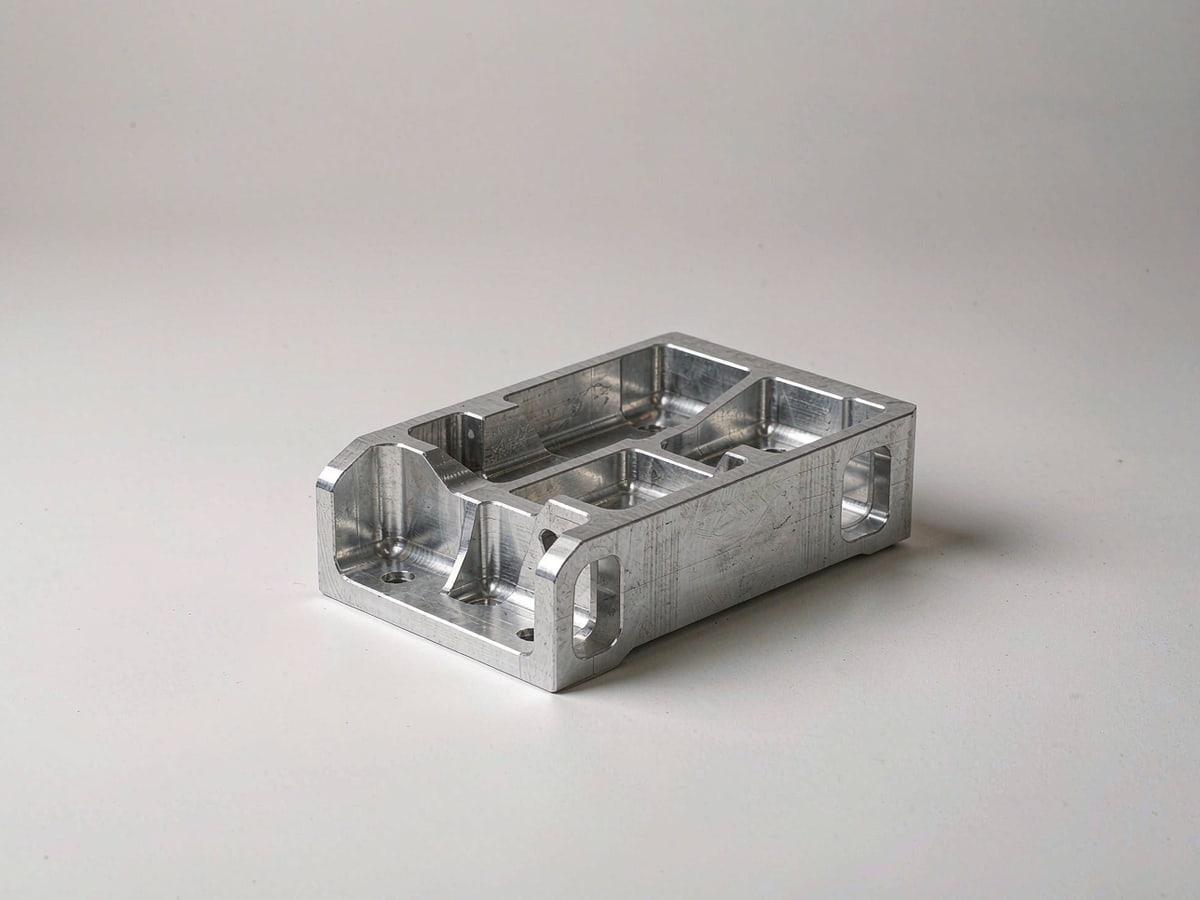
Most first-time buyers read a CNC quote the way they read a utility bill: a single number, accepted or rejected. That is the expensive way to do it. The quote has a structure, and the structure is where the leverage is. Two drawings with the same weight of metal can differ by a factor of five in price, and the difference is almost never the material — it is how the part is set up, how long the cutter is in the metal, and what happens after it comes off the machine.
The five things you are actually paying for
Every machined prototype quote contains the same five drivers, whether the shop itemises them or not. Setup and programming covers fixturing, tool selection, the CNC program and the first-article check. Machine time is the cutter in the metal, including tool changes. Material is the stock you buy and the part of it you machine away. Surface finish and secondary operations — anodising, plating, heat treatment, passivation — are usually a separate sub-supplier with their own minimums. Inspection and documentation close the list, and rise with the number of critical features.
| Cost driver | Typical share | What moves it most |
|---|---|---|
| Setup & programming | 30–50% | Number of setups, fixturing complexity |
| Machine time | 20–40% | Feature count, small radii, deep pockets |
| Material | 5–15% | Stock form and price, buy-to-fly ratio |
| Finish & secondary ops | 5–20% | Process choice, sub-supplier minimums |
| Inspection & FAI | 5–10% | Critical features, CMM vs hand tools |
The percentages are indicative for one-off and low-volume work in common materials — the point is the shape of the split, not the exact numbers. For a single bracket, setup often outweighs everything else combined. For a hundred of the same bracket, it nearly disappears. That single fact explains most of the pricing behaviour buyers find strange.
Setup is the hidden half of a one-off
A machinist does not start by cutting metal. They read the drawing, choose the stock, decide which face goes up first, build or select a fixture, set tool lengths, prove out the program in air, and cut a first article before the batch runs. On a simple part that is a couple of hours; on a part with five faces and an odd envelope it can be most of a day. None of it scales down when you order one piece, which is why a shop that quotes one part at the cost of ten is either running lights-out automation or guessing.
The practical consequence: anything that reduces setups is worth more than anything that reduces cutting time. A part that can be completed in two orientations instead of four can be dramatically cheaper at the same tolerance, because each orientation is a fixture, a datum change and a re-prove. When you send a drawing, the most useful question you can ask is not "can you make it cheaper" but "how many setups does this need, and can the design use fewer".
Machine time follows geometry, not weight
Two parts of identical weight can have wildly different cycle times. What drives the clock is the number of features, the size of the cutter those features force, and how often the spindle has to stop for a tool change. A 50 g part with forty small holes takes far longer than a 500 g part with one pocket, because the small holes demand a small cutter, a small cutter means a shallow depth of cut, and a shallow depth of cut means many passes.
- Thin walls vibrate and need light passes, sometimes several times, to hold a flatness that a thick wall holds for free.
- Internal corner radii below about 3 mm force a small end mill; a radius above 3 mm lets the shop use a standard cutter at full depth.
- Deep, narrow pockets are the worst case: poor chip evacuation, tool deflection and a real risk of scrapping a nearly finished part.
- Every tool change is a stop. A design that needs eight tools will take noticeably longer than one that needs four, at the same weight.
None of this is visible in the CAD file until someone who has to cut it looks at it — which is exactly what a DFM review before quoting is for. A shop that returns a drawing with "reduce these six corner radii and this quote drops" has told you more about itself than any certificate on the wall.
Material is a multiplier, not a line item
Material is usually the smallest line in a prototype quote, but it is the line with the widest range. Aluminium bar is cheap and machines freely. Stainless is slower per cut and eats tools faster. Titanium and PEEK sit in another category: the stock itself can cost more than the whole aluminium equivalent, and both demand conservative speeds and feeds that stretch machine time further. Choosing aluminium 6061 over a stronger grade is often the single largest saving available on a machined part, provided the test the prototype has to pass still passes — our note on choosing between plastic and metal covers that decision order.
One trap worth naming: billet versus near-net stock. Machining a titanium part from solid bar can throw away eighty per cent of the material you paid for. Where the geometry allows, a casting or a forged blank closer to final shape changes the economics — at the cost of a tool, which only pays back above a quantity threshold worth discussing before you commit.
Surface finish is a second supply chain
Almost no machine shop anodises in-house. Finish is subcontracted, which means it carries its own minimum charge, its own lead time and its own failure modes — a batch held for a re-blast delays the whole order, not just the finishing step. This is why the finish choice belongs in the cost conversation from the start: anodising a small aluminium part can add a meaningful percentage through minimum-order effects alone, and powder coating on a prototype run is often the more expensive route unless the part genuinely needs the thicker, tougher film.
The cheapest finish is usually "as machined", and for functional prototypes it is frequently enough. Deciding to skip cosmetic finishing on a first iteration, then adding it once the geometry is frozen, is one of the most reliable cost moves in prototype work.
Why one part and ten parts cost almost the same
Because setup does not amortise over one. The second through tenth parts add only machine time and material, so ten pieces typically cost far less than ten times the price of one — but still more than a buyer expects from the per-piece headline. Above roughly twenty to fifty pieces, depending on geometry, the calculus shifts again: machining time per part keeps falling while print and casting routes start to look competitive, and at hundreds of pieces a soft tool or a mould enters the conversation.
The useful move is to price the same drawing at the quantities you might actually need — one, ten, fifty — before choosing a route. Shops that refuse to quote three quantities are telling you they quote from a template.
Eight levers that cut price without cutting function
- Standardise wall thickness. One wall thickness for the whole part lets the cutter run at a constant, efficient depth of cut instead of sneaking up on thin sections.
- Keep internal corner radii at 3 mm or above wherever function allows — it is the single highest-return change on most drawings.
- Relax tolerances that do not carry function. Title-block the general case and call out only the fits and datums, as our ISO 2768 tolerance guide sets out.
- Avoid tools below about 1 mm diameter unless the feature genuinely needs them; sub-millimetre cutters are slow, fragile and expensive to break.
- Reduce face count. Features reachable from two or three orientations cut setup, fixturing and re-proving out of the quote.
- Choose the cheapest material that still passes the test, and state on the drawing that it is a prototype substitution if it differs from production.
- Batch by material. Several parts from the same bar stock in one setup is far cheaper per piece than the same parts ordered separately.
- Ask for the DFM notes before asking for the discount. A shop that marks up the drawing first gives you a cheaper part; a shop that discounts first usually cuts the inspection.
What a serious quote contains
A real quote is itemised: setup, machine time, material, finish, inspection, with the assumptions written down — stock form, tolerance basis, finish specification, quantity break points and validity period. It comes with DFM notes where the drawing could be cheaper to make, and it states what was excluded. Ours arrives within 24 hours of receiving a STEP file and a drawing, reviewed by an engineer rather than generated from a form, and the parts are machined at ISO-certified partner factories in Dongguan and Shenzhen. The quality and NDA page describes what you can ask to see before you order, including inspection records and certificate copies.
The shares and ranges in this note are indicative for machined prototypes in common materials, not a price list. The real number for your part depends on geometry, tolerance, finish and quantity — send the STEP file and the drawing to the instant quote page and you get a firm, itemised quote with DFM notes within 24 hours.